


From snow-covered prairies and spring wildflowers to summer skies and autumn gold, Kansas photographers share the landscapes and moments that make every season memorable.
At the start of each year—after the holidays have faded and the resolutions have been made—Kansans know what’s coming. We buckle down and embrace at least two more months of cold, relentless winter. But honestly? Winter carries a stark, minimalist beauty that shouldn’t be missed.
Every season has its own kind of beauty. Especially in Kansas, where a person can experience all four seasons in one confusing day. As winter passes, snow-covered prairies and ice crystals melt into tallgrass greens. Thousands of sandhill cranes migrate over the wetlands in spring, delivering one of the greatest wildlife sightings in North America. Controlled burns bring life back to the earth while hopeful farmers rise before dawn to plant their crops mile after mile.
Then comes the unbearable heat of summer, though we all know it’s not the heat that gets you—it’s the humidity. Grain trucks line up to haul the wheat that feeds the country. County fairgrounds fill with enticing aromas of corn dogs and funnel cakes. Late nights offer free symphonies of cicadas playing their mating songs. Tornado season arrives and Kansans either hunker down or stand on the front porch to watch the storms roll in.
Eventually, the heat breaks and the harvest is plentiful. Pumpkin patches and corn mazes fill our fall days, and football games take up our evenings. Monarch butterflies pass through on their long journey to Mexico. Winter is coming, so we go outside as much as possible before the cozy season comes full circle.
All the seasons offer something worth admiring. We talked with several of our photographers about what each season means to them and asked them to share the photos that capture the state at its most beautiful. Here’s what they had to say.
WINTER
There’s no better place to see the Kansas prairie under snow than the Flint Hills. “The roads are pretty good where I normally photograph, so I can get out there even if it’s a little snowy or icy,” photographer Scott Bean explains. “I love the color palette here. Winter twilight is when we get that pink band in the sky.”
That rosy glow on the horizon is the Belt of Venus, Bean adds. Just beneath it lies a deep, dusty blue band, which is the Earth’s shadow. As twilight progresses, both bands climb higher in the sky.
“Winter is a time of rest,” Bean says. “It’s about getting ready for next year. What I like about winter is that it’s really quiet. The world is calmer, not as active. It might be cold, but there’s a peacefulness that is special for the season.”
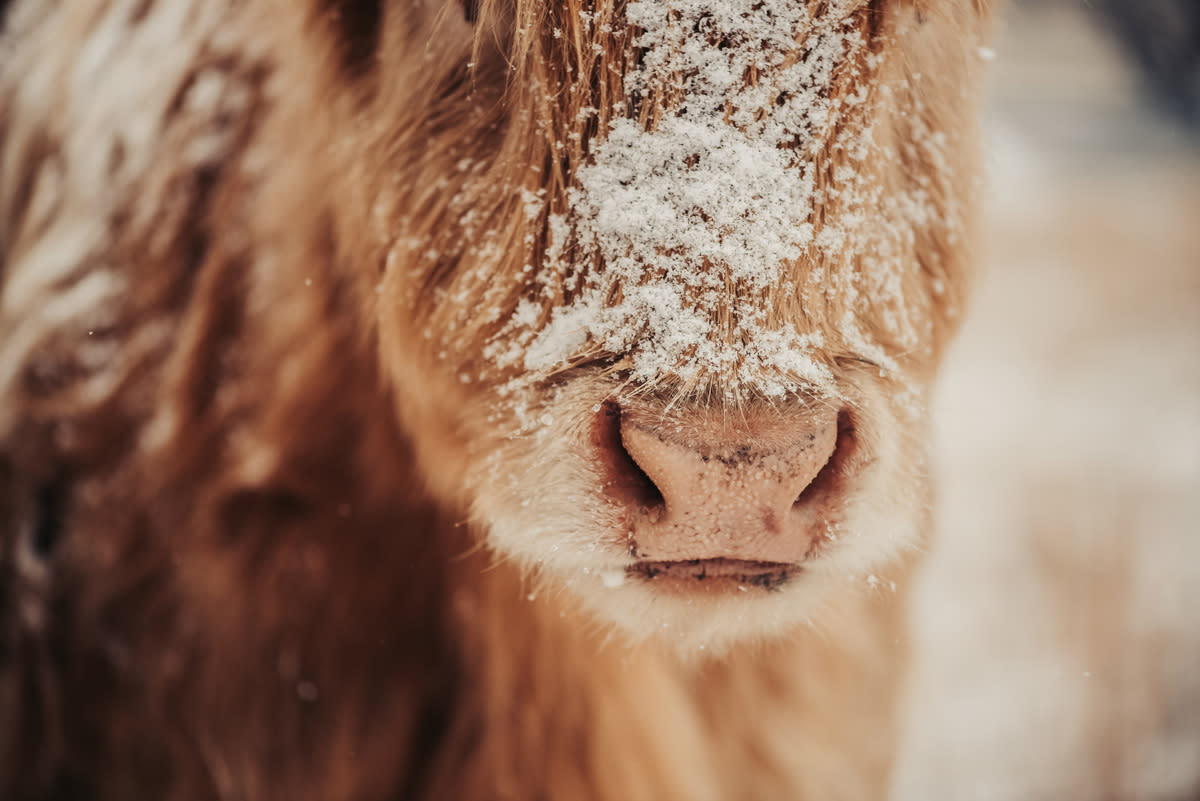
When photographer Amanda Overton visited her friend’s hobby farm outside Rantoul, she was surrounded by some of its shaggiest residents. “My friend breeds Highland cows,” Overton says. “In the winter, they jump and play in the snow, just like dogs. You can pet them, brush them, give them treats. They’re fun to be around.”
The youngest of the herd, pictured here, stood patiently for Overton’s camera, snow dusting her nose. The calf was a reminder that winter doesn’t have to keep anyone indoors. “I love to get outside during the winter,” Overton says. “I grew up with side-by-sides and four-wheelers, and now have a Jeep. We like to get out and explore the backroads and see everything covered in snow.”
SPRING
In Kansas, spring arrives with a buzz. Warmer weather and spring rain coax the flowers open, and the bees are right behind them.
Overton’s father and stepmother own Purple Meadows Lavender Farm outside Spring Hill, where they make all kinds of lavender products, including lavender-filled teddy bears, candles, soaps and simple syrups. One sunny day, after it opened for the season, she found bees crowding the fragrant blooms.
“You could hear the buzzing everywhere. It was so loud,” Overton says. “To me, bees scream spring. Bees bring in growth and new beginnings. They’re very important to the ecosystem and help our farmers with their crops.”
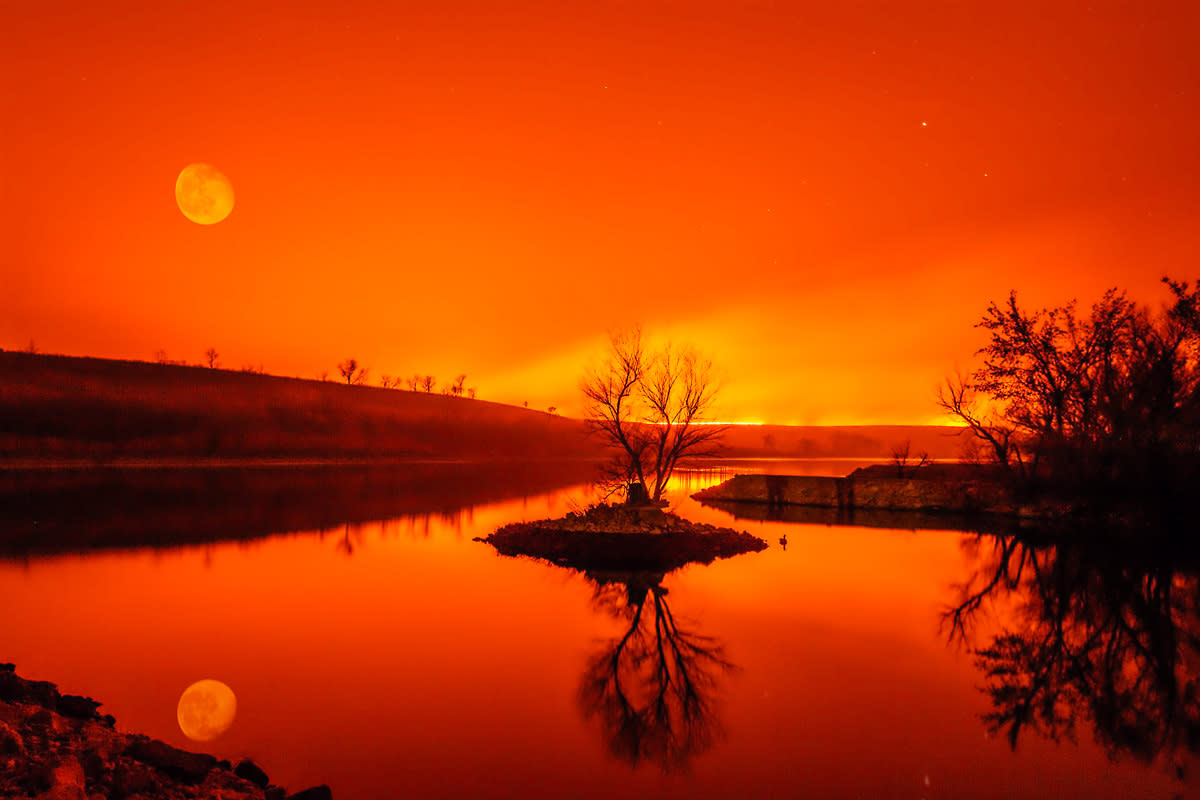
Each March and April, controlled burns sweep the prairie, clearing away the old growth to make room for the new. Photographer Bruce Hogle likes to spend the first weekend of April in Cottonwood Falls, photographing the burns with a couple of photographer friends.
“After a long day of shooting near Elmdale, we started back to Cottonwood Falls, all the while looking for any telltale reddish glows in the sky,” Hogle says. “As we drove east toward Chase State Fishing Lake, I could see a glow that looked like it might be near the lake.”
Without asking his passengers, he turned toward the glow, and the unplanned detour paid off with this vivid scene. “The bonus? The moon rose at 11 p.m., so I was able to create this image in-camera with a double exposure.”
SUMMER
Summer in Kansas rewards the curious. Some of the state’s best views are tucked away in lesser-known corners. “A lot of people tend to knock on Kansas because there is so much private property,” Bean says. “And yes, it does have its limitations. But you can still see some amazing things.”
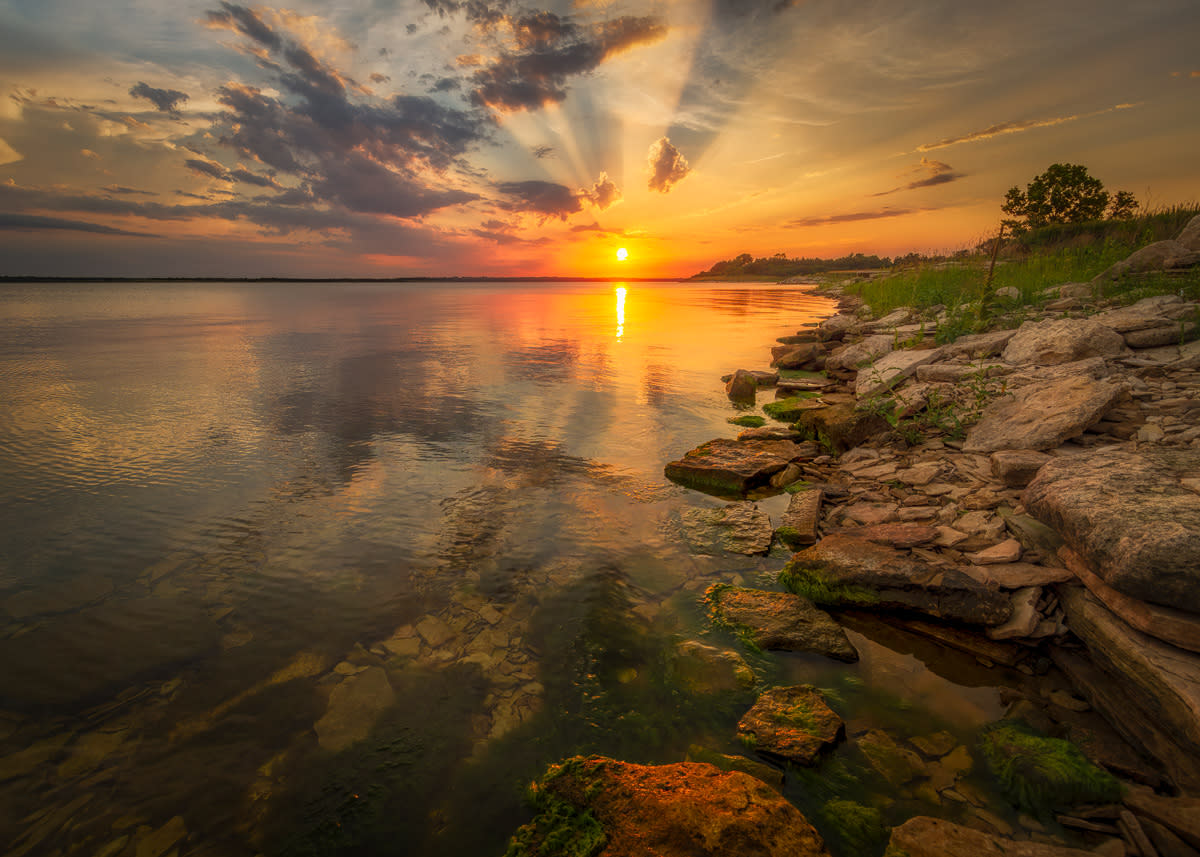
Bean found this spot while hiking along Milford Lake. “It was one of those special moments you couldn’t plan for or predict,” he says. “I don’t take any credit for this one. It’s all nature. I love moments like this.”
Milford is the state’s largest artificial lake, with plenty of room for campers, boaters, anglers, wildlife watchers and hikers. “It’s nice to be around water in the summer,” Bean adds. “On a hot day, you can finish off with a swim in the lake or sitting by the shore.”
Don’t fear the dirt and gravel. Kansas’ back roads lead to some of the state’s most stunning views, especially in summer, when the land is at its greenest. In this photo, the Flint Hills stretch to the horizon, part of the last large expanse of tallgrass prairie in North America.
Hogle captured this early morning scene in Chase County along G Road, a few miles south of the Flying W Ranch. “The composition formed by the clouds is what caught my eye and compelled me to stop and compose this photograph,” Hogle says. “I always feel at peace in the rolling prairie.”
FALL
Autumn is the season for pulling on a cozy knit, breathing in the crisp air and taking leisurely strolls, crunching leaves along the way. But in Kansas, the season doesn’t only blaze from the treetops. It also rolls across the prairie in coppers and golds.
“Fall is my favorite time of year,” Bean says. “I just love those cool fall mornings. And I think the color on the prairie is underrated, especially in the fall.”
Bean shot this image at one of his favorite spots, just 15 minutes from his home north of Manhattan. “It’s a fantastic view out over the Flint Hills,” he says. “I had gone to catch the sunrise with a family member. Nature really cooperated that day. I love how the early morning light shows off those textures and shapes.”
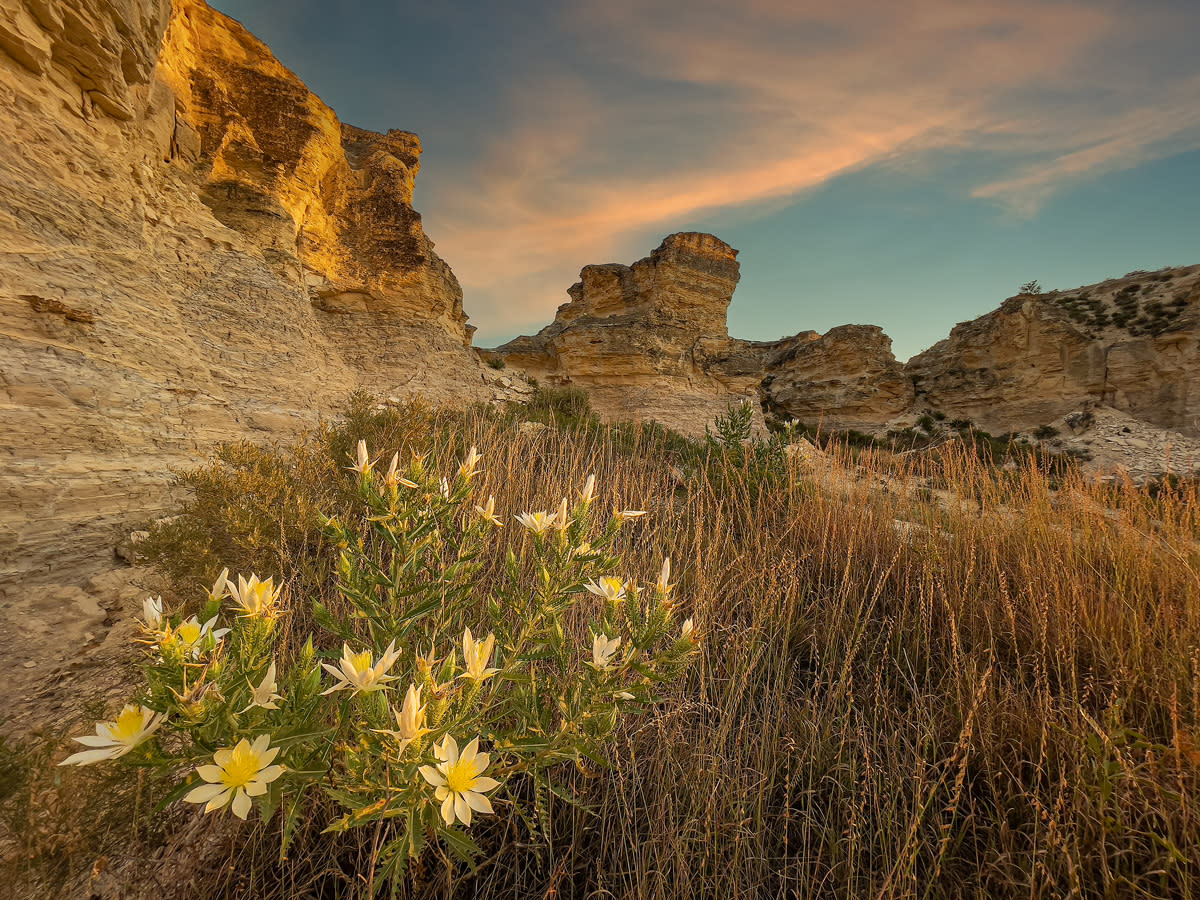
In fall, the sun sits lower and light turns warm. Late in the day, it washes the pale chalk of Little Jerusalem Badlands State Park in Logan County in shades of gold, pink and amber. Rising from the western Kansas plains, the formations are remnants of an ancient sea, and few places show off autumn’s glow so well.
“I shot this during an off-trail hike and photo event with Little Jerusalem Badlands State Park naturalist Sara Kay Carrell,” Hogle says. “The clump of chalk lilies, whose blooms don’t open until the very late afternoon, caught my eye, as did the wispy clouds in the south reflecting the warm rays of a setting sun.”


