


Editor's Note: This article was originally published winter 2001.
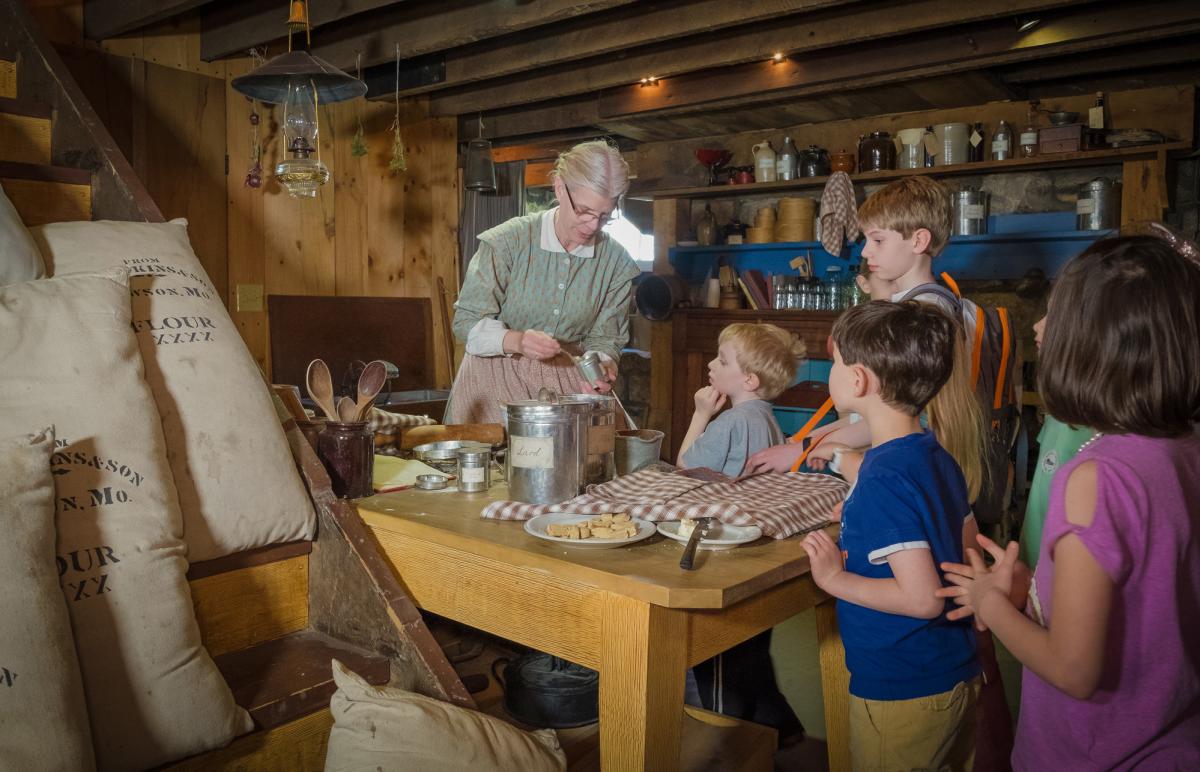
Wendy Burkett lifted her long skirt as she led the way into the 1865 cellar. Far from being a musty hide-away, this was a long-awaited haven for stagecoach passengers making their way westward.
The Mahaffie Stagecoach Stop and Farm in Olathe is the last surviving authentic stagecoach stop on the Santa Fe Trail. Lucinda and James Beatty Mahaffie operated the "home station" from 1863 to 1869, serving meals in the cellar kitchen to as many as 70 to 80 travelers each day.
"It was unusual to have a full-size cellar like this, but the Mahaffies knew when they built the house that they were going to be feeding passengers," said Wendy Burkett, interpreter.
Long wooden tables fill the west end of the combination dining room and kitchen. It's easy to imagine the clatter of spoons and bowls as Burkett describes Lucinda, her daughters, and a hired girl dishing up a hearty soup or stew for passengers. The family had 20 milk cows and a big garden. Mahaffie also was the first farmer in Johnson County to grow wheat.
Mahaffie moved his family here in 1857 from Jasper County, Ind., three years after the Kansas-Nebraska Act opened the two territories to homesteaders. He originally set his sights on Council Grove, but the family decided to settle in Olathe after learning about opportunities here.
They bought three lots in town-one with a new 20-foot by 25-foot home and became one of the first 16 families to settle the town of Olathe. But, a longtime farmer, Mahaffie immediately began searching for land. When 160 acres along the Santa Fe Trail became available, he purchased the property for $1.25 an acre. He set his house on skids, and two teams of oxen dragged it more than a mile to the new farm.
In March 1863, the Barlow & Sanderson Stagecoach Line contracted with Mahaffie to provide a stagecoach stop on their twice-a-week Kansas City to Fort Scott route. "We also have documentation that at least some of William Clark Quantrill's bushwackers looted the farm on their way to raid Olathe in 1863," said Jack Tinnell, site director. "The stop is a significant Border Wars site."
Since 1821, the Santa Fe Trail had been the principle trading route to Mexico and the Southwest, first starting at Franklin, Mo., and later with starting points at Independence and Westport Landing, now Kansas City.
The Barlow & Sanderson company soon added a daily route from Kansas City to Lawrence, and a weekly route from Kansas City to Santa Fe. By 1867, the busiest year for the Mahaffie Stagecoach Stop, there were six stagecoaches stopping each day. About 100 horses, owned by Barlow & Sanderson, were stabled on the farm and were cared for by employees who also worked on the stagecoaches.
In 1865, Mahaffie hired a stone mason and crew to build the native limestone house and a two-story ice house that still stand today. Both, along with a wooden pegged barn, are listed on the National Register of Historic Places. "This is the only stagecoach stop still standing and we think it's because the man who built it was so good," said Jack Benton, who volunteers at the site. He pointed out the 2-foot-thick walls and the 2-foot by 12-foot walnut beams.
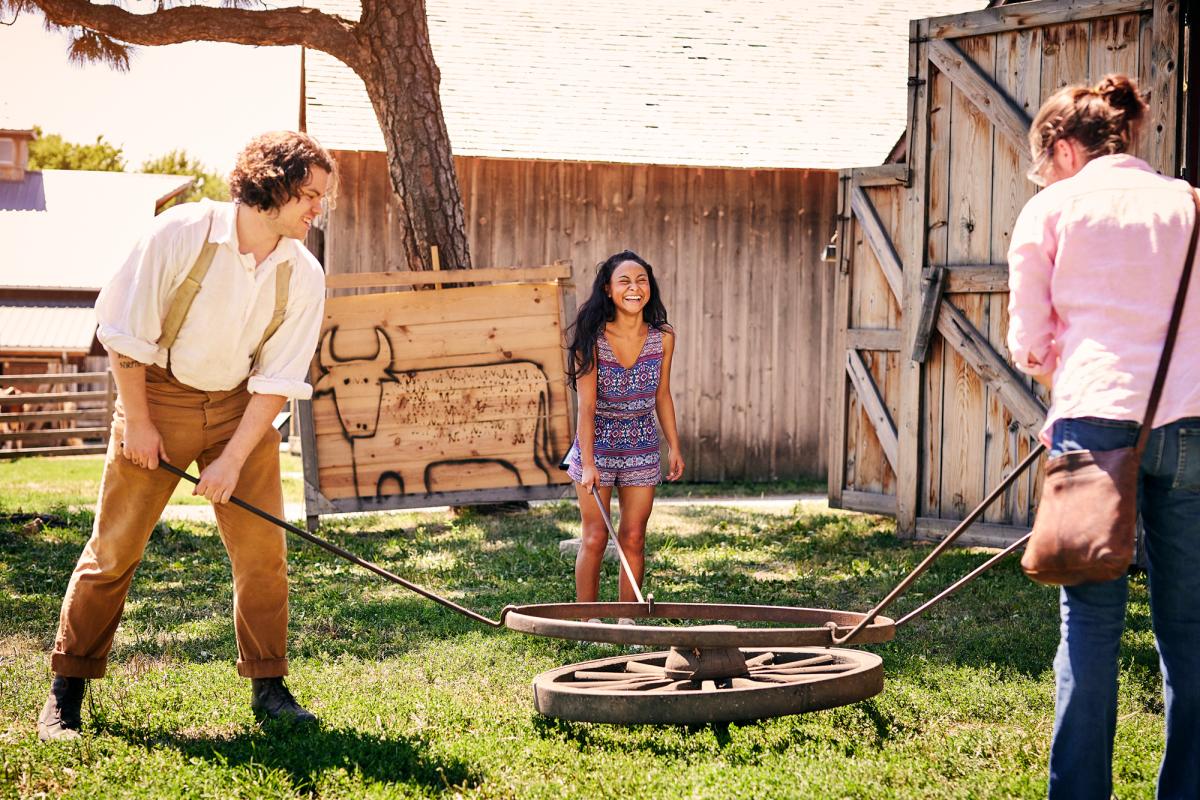
"They had 30 minutes here to pull their tired horses in and put on fresh ones," Benton said. "The stagecoach made 60 stops between here and Santa Fe, a 900- mile trip."
In 1869, the days of the stagecoach in Olathe ended when the Kansas City, Ft. Scott and Gulf Railroad extended the line to Olathe. Mahaffie didn't need to fret about the lost income, however. The shrewd businessman was one of the first ten investors in the new railroad. Through the decades, the Mahaffie farm changed hands six times before the City of Olathe purchased it in 1979. Although additions were made. By different owners, the original two-story structure remains with porches stretching across both levels.
Today, the Mahaffie Stagecoach Stop and Farm is recognized as an official Santa Fe Trail site by the National Park Service. The State of Kansas has also designated it as the Official Santa Fe Trail Stagecoach Stop and Museum of Kansas. Re-enactors perform a variety of activities. A regular is Martha Kenning, a Civil War-era laundress, who strings a rope between the trees and hangs out clean dresses and drawers to dry.
"If the clothes were very dirty, you put them in a wash boiler with turpentine, borax, and shaved soap and boiled the 'mixture," she said. "After they were boiled, you put them in a traditional wooden washtub and rubbed or poured gin on it. Ox gall was used as spot treatment."
Nearby, Chris Patterson worked on her sewing while her brother, Jason Brown, played the part of a Santa Fe Trail boss. The two were born on the Santa Fe Trail in Gardner where the Trail split north to Oregon and California, and south to Santa Fe. Last April, Jason and his bride, Sara, were married at the Mahaffie Farm. Jason's living history re-enactments stop there, however. "I'm not giving birth on the Santa Fe Trail," Sara declared.
Other living history events are held throughout the year at Mahaffie's, including a Civil War battle each April involving about 600 re-enactors, and Buffalo Bill's Wild West Show each October.


