


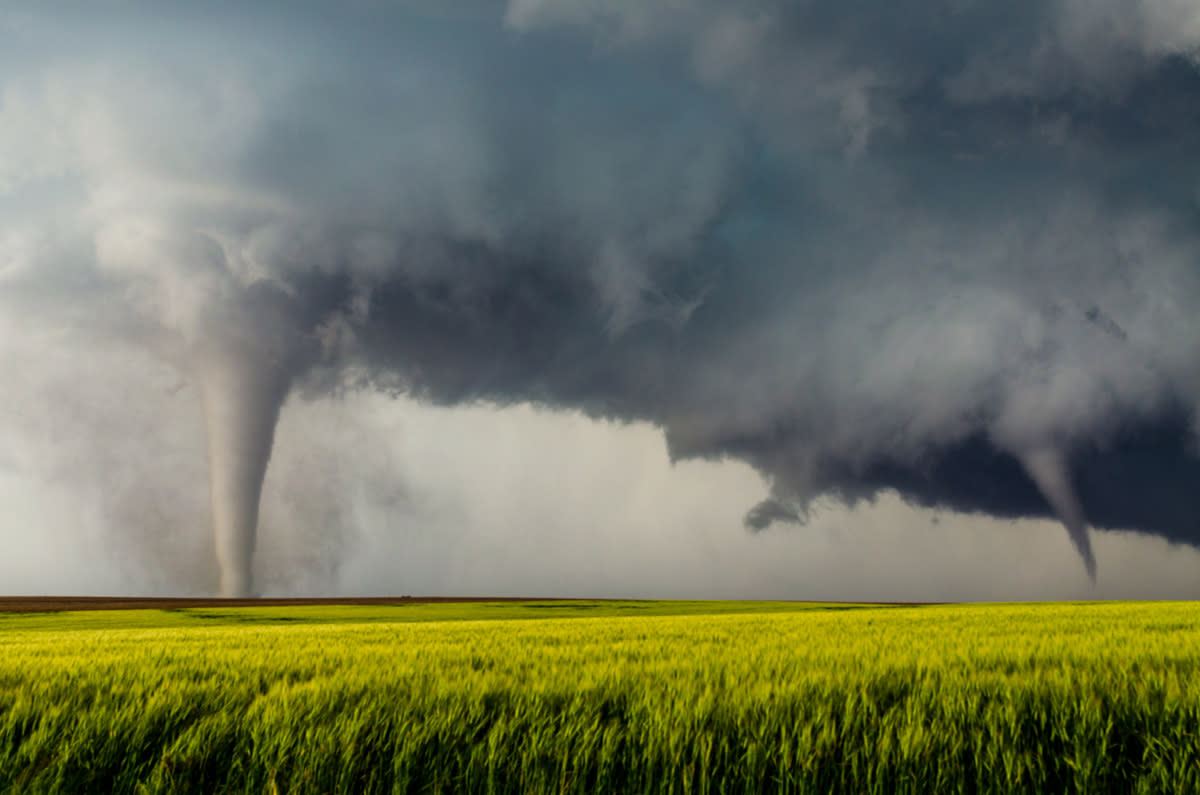
Calm one minute, furious the next, Kansas’ extreme weather proves its unpredictability is its only constant
As surely as Kansas weather has shaped our lands, it has also shaped who we are as Kansans. Weather is never far from the discussion. Go where the locals gather and you will hear it on the tips of bantering tongues.
“Is it hot enough for you?”
“Cold enough?”
“Dry enough?”
“Windy enough?”
Growing up, Ross Janssen heard it all. “I heard everybody talking with my parents … everybody was discussing it,” says Janssen, chief meteorologist for KWCH-TV in Wichita, a CBS affiliate that serves more than two-thirds of Kansas. “They’d be talking about rainfall amounts and how it impacts everybody. Growing up on the farm, you’d see storms blow in—crazy snowstorms and thunderstorms. You’d get caught out in it sometimes, whether you were on a combine or riding a horse. It impacted everything we did.”
Kansans live by extremes. The coldest cold, recorded on February 13, 1905, in Lebanon, was minus 40 degrees. The hottest hot was 121 degrees near Alton in July 1936.
So, what is it about our state that attracts such extremes? Kansas weather is most often affected by three elements: wind streams from the Rocky Mountains; dry desert air from Arizona and New Mexico, and moisture from the Gulf of Mexico.
“The Rockies to the west act like a barrier or a wall that helps funnel the Gulf humidity right up into the Central Plains,” Janssen says. “If it weren’t for the Gulf, we certainly wouldn’t have nearly the amount of rainfall that we typically get in a year’s time. If it weren’t for the dry desert air coming from Arizona and New Mexico, we certainly wouldn’t get the severe thunderstorms that we traditionally see in Kansas.”
Another reason Kansas experiences such extremes? Kansas is positioned halfway between the equator and the North Pole. “The wind at 20,000 to 30,000 feet above us is a lot stronger in this part of the world than it would be if further south, closer to the equator,” Janssen says.
Thanks to these extremes, Kansas is a place where fortunes can be made and lost. It is a place that embodies the raw power of nature … and the enduring spirit of those who call this unpredictable land home.
The following historical stories are as fascinating as they are cautionary.

Gales of Destruction
The ties binding Kansans and tornadoes may date back to 1879, when a large tornado decimated the small town of Irving in northeast Kansas. Newspaper accounts of the damage and the suffering of townspeople captured the attention of newspaper readers across the nation, including one L. Frank Baum, author of The Wonderful Wizard of Oz.
Some historians suggest Baum initially planned to set his book in South Dakota but changed the setting to Kansas after Irving made national news by becoming the only town to ever be hit by tornadoes twice in a single day. He may also have paid tribute to the victims by naming his main character Dorothy Gale, as six of the 19 victims in Irving were members of a family who shared the surname Gale.
May 20, Cyclone Day
In Codell, a small town in Rooks County, May 20 is known as Cyclone Day, as it was on this day that a tornado struck the town in 1916, 1917 and 1918. Each year’s tornado seemed to grow in strength, says Paul R. Albert on his website Codell Kansas Tornadoes.
“A tornado can strike anywhere,” says Chance Hayes, a retired warning coordination meteorologist for the National Weather Service in Wichita. “Rivers, mountains, nor cities … none of that is going to keep a tornado from happening. You know, they always say that big cities won’t get hit by a tornado, but that’s false. … Why would Codell get hit on the same day, three years in a row if they say the same place can’t get hit more than once?”
Storms That Defy Our Beliefs
Prior to 1966, Kansans believed that Burnett’s Mound, a Pottawatomie tribe spiritual site, protected Topeka from ever facing the destructive nature of tornadoes. However, on June 8, 1966, a tornado swept over Burnett’s Mound and tore through downtown Topeka, killing 16 people and injuring more than 500.
Bill Kurtis, then a 26-year-old law student at Washburn University, was filling in at WIBW TV when he received reports of a tornado heading toward Topeka. He went on air and told viewers, “For God’s sake, take cover,” according to a WIBW news story on Kurtis in 2021. This significant moment changed the trajectory of his career. Today, his voice is one of the most recognized voices of American broadcast television.
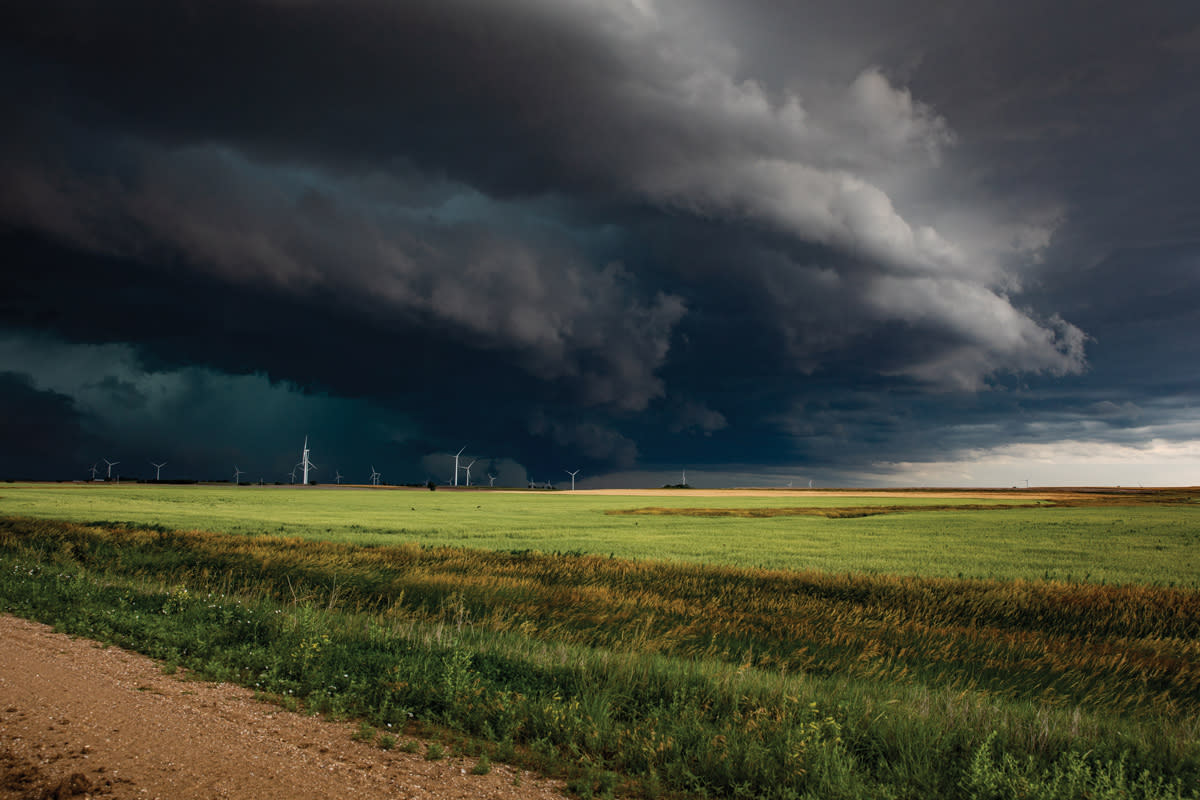
Storms That Turn Deadly
The deadliest tornado in Kansas occurred in Udall on May 25, 1955, at 10:35 p.m. Measuring three-quarters of a mile wide, it killed 77 people—about a quarter of the small town’s population. A tornado watch had been issued earlier in the evening, but the updated watch didn’t reach local broadcast media before their 10 p.m. newscasts. As a result, many Udall residents went to bed thinking the watch had expired and the threat of severe weather had passed.
Survivors later reported that they thought they heard the deep rumbles of a late-night train shortly after 10:30 p.m. Other survivors say that having sensed danger throughout the day, they took to their storm shelters for the evening.
Another small town in Kansas was virtually erased by a massive tornado more than half a century later: the Greensburg tornado.
On May 7, 2007, this tornado had a similar trajectory and was of similar size to the Udall tornado, with one notable difference: the 1955 tornado in Udall killed 77 people, but the 2007 tornado in Greensburg killed 10.
Weather officials credit the lower death toll in Greensburg to advancements in radar, the storm-spotter network established after the Udall tornado, and better communication systems. “I’m probably a little bit different from most people because I’ve come to the conclusion that, here in Kansas, we have a deeper knowledge of weather, meteorology and tornadic-type storms because we’ve grown up with it and it’s been spoon-fed to us for years,” Hayes says. “You don’t need to open your windows; a tornado will open your windows for you with the debris that hits before the tornado even gets there.”

“I haven’t always been a proponent of someone running to their shelter as soon as the sky turns dark or the siren goes off,” he adds. “But I’ve always been a huge proponent of getting more information.” During a storm, Hayes encourages everyone to turn to their TVs, radios or phones for the most up-to-date information. Local TV station weather apps are crucial for getting the most current information, so make sure the app is set to access your location and turn on immediate notifications.
Storms that Haunt Us
Janssen remembers the storm of April 14, 2012. It was a tornado that ventured 6 miles east of his mom and dad’s farm.
“I was [on the air] looking at the radar and talking about the highways and the county roads that it was crossing and thinking to myself that I’ve driven home on them hundreds of times and gone down all these roads,” he recalls. “I know the people that live here and there, and I just hope in those moments that these people are paying attention to the weather.”
“When you are covering something like that, you can’t let your mind go into that mode,” he continues. “You must stay focused on the radar and the science and communicating so that you are doing an effective job. Because if the panic and the reality of it start to set in, your wheels might just come off in the middle of covering severe storms.”
The storm that Hayes will never forget struck a farm just south of Harper on May 12, 2004.
“We found ground scouring [near the farm], at least half a mile wide,” Hayes says about the visible damage this particularly strong tornado left in its wake. “The home was obliterated and completely gone. … All their barns and sheds were gone. But [the family] miraculously survived in the basement.”
“There was a large tree that had fallen or been blown into the basement, from one corner to the next. They were sitting [under] that,” he adds. The tree, which had deflected falling debris, had spared their lives, Hayes explains. “I had never seen anything like that in person. How anyone could survive that was miraculous to me.”
Hayes cites the Hoisington tornado of April 21, 2001, as another haunting tornado. It destroyed 200 homes and 12 businesses, according to the National Weather Service.
“It went right through the town, and unfortunately, there was one fatality,” Hayes says. “It’s amazing we didn’t have more because that tornado was originally unwarned. It didn’t get warned until it was moving through the community. The fact that they had prom going on and several different activities that night—it was just amazing more people were not injured.”
Visiting the scene after the devastation was very humbling, he adds. “At one homestead, the house was completely gone. But the shoes and gloves that the individual had taken off before they went inside were still sitting on the steps.”
There’s fury in some Kansas storms and forgiveness in others. Some pray when the storms come. Others pray when they don’t. And yet, there is something undeniably mystical about our changing weather.
“Enjoy it,” Janssen says. “Enjoy the Kansas weather. It’s here and now and it could be very different tomorrow. Appreciate the drastic changes. Know the power of Mother Nature. … We live in a place that gets all kinds of weather. We don’t have hurricanes, but we have wind. We have heavy rains. We get snowstorms. We get four seasons of drastic weather. And that’s not something that every place can claim.”
Beyond Tornadoes
Sometimes during the winter, when the conditions are just right, Kansans might wake up to a breathtaking phenomenon known as hoar frost.
Unlike regular frost, which condenses onto an object then freezes, hoar frost immediately freezes upon coming into contact with objects below freezing, skipping its liquid water stage. Think of barbed wire adorned with ice crystals or tree branches covered in feathery ice.
It is a photographer’s dream to capture the ice crystals before the rising sun melts them.


