


From Calabria to the Flint Hills, one artisan’s journey reshapes the legacy of the American cowboy boot
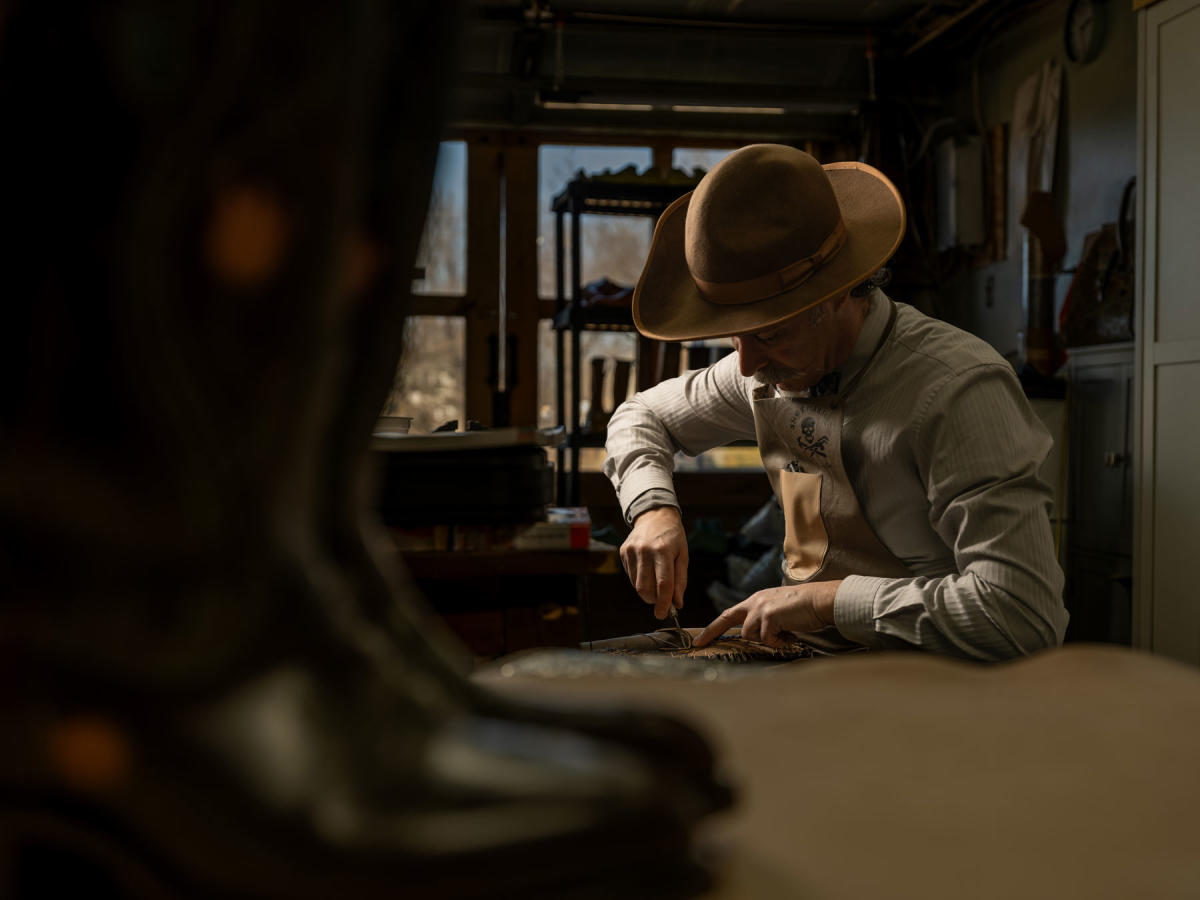
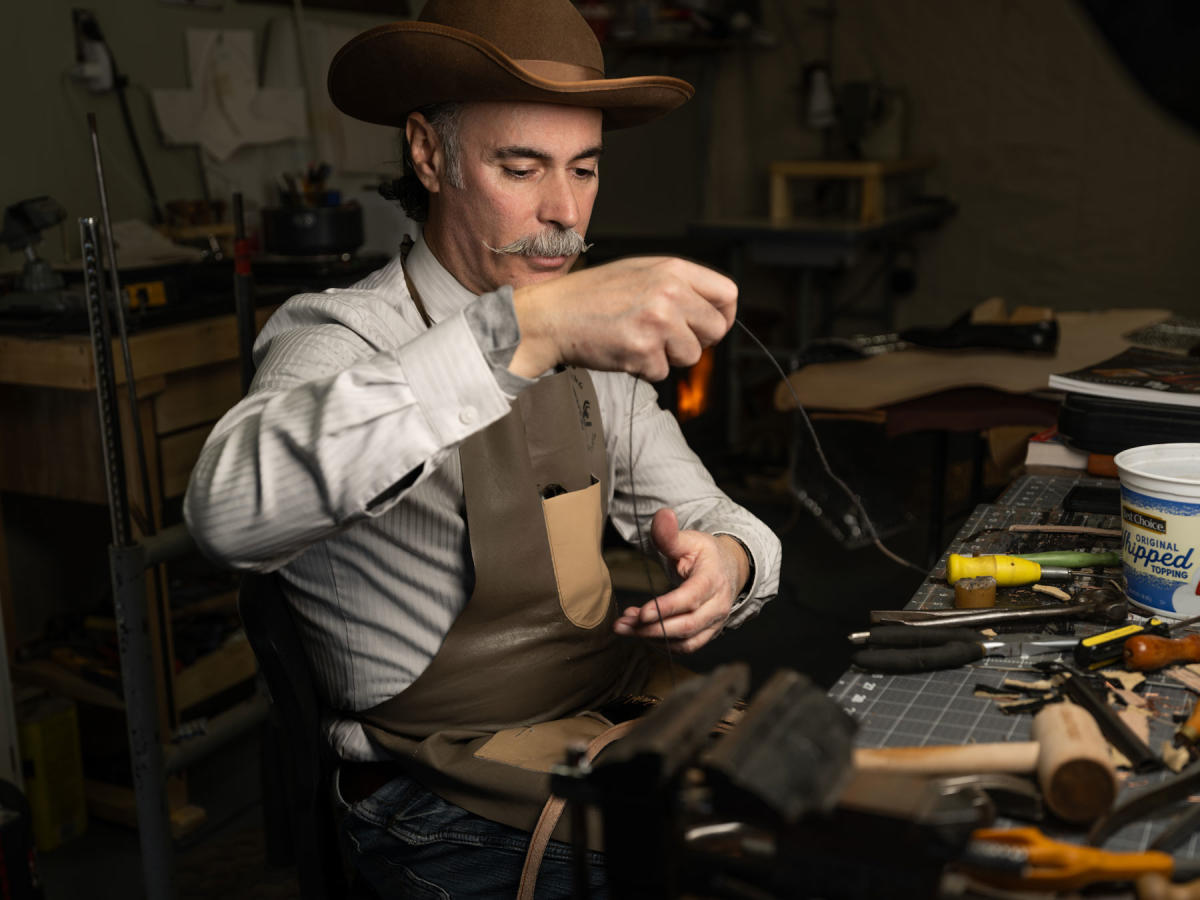
Sam Vasta is a master shoemaker from Italy, and he looks the part. In the workshop at his home near Eureka, he sports a trim gray beard and mustache along with a homemade, knee-length leather apron. Although he began his career making traditional fine shoes for men and women in Europe and the northeastern United States, he now earns his Midwest bread and butter crafting cowboy boots. And crafting cowboy boots, he says, is a lot more fun.
“It’s like writing a song,” Vasta says, describing the surge of creativity he unleashes while designing the shaft of a pair of custom boots.
 AARON PATTON
“A loafer is a loafer,” he adds. There’s only so much you can do to a shoe to make it stand out. But the cowboy boot, because of its culture and tradition, allows for more creativity in decorative design. This may be in part because of its more expansive palette.
People who order cowboy boots often bring their own dreams into the shop. Vasta’s first boot customer at his Kansas shop was a woman from Emporia. She wanted flowers. She wanted color. And she wanted to incorporate her ranch brand.
“Let me do a sketch for you,” Vasta told her, and set to work.
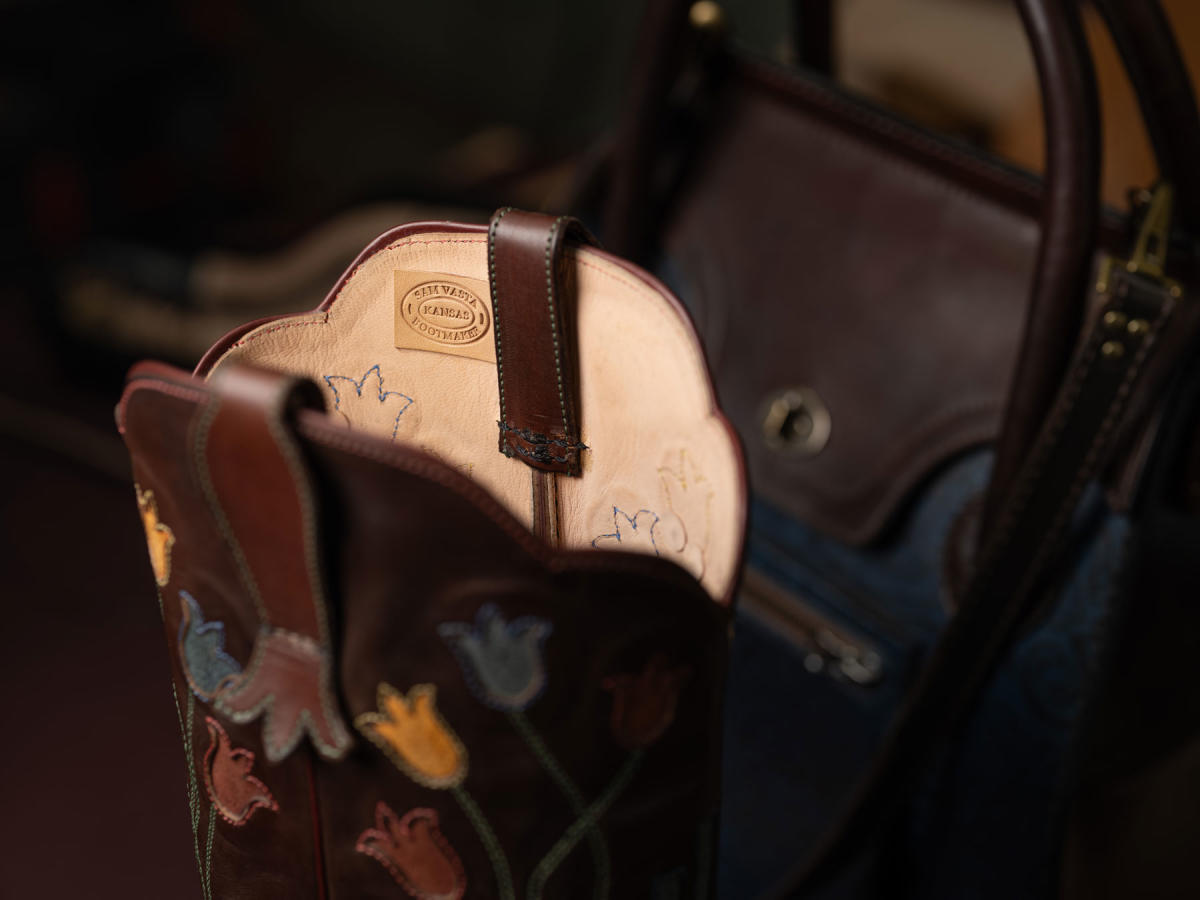
Vasta always submits drawings and color samples to his customers. For this floral-themed commission, he researched various designs and discovered an ornate pair of boots made famous by legendary Hollywood Western star Tom Mix. Drawing from that inspiration, Vasta designed a repeating four-color tulip motif and placed her ranch brand on both the front and back of the boot shaft.
His boots start at $3,000 and go up from there. “There is a lot of work in a pair of custom boots and many steps in the process,” he says. “It takes me at least a full two weeks to complete a pair. It may seem like a lot of money, but I would bet a professional plumber makes more per hour than I do.”
But how does a master shoemaker from Italy end up in southeast Kansas? Vasta was born in the Calabria region of southwest Italy, commonly known as the “toe” of the boot. He still remembers walking with his mom through sprawling outdoor markets, bustling with various craftsmen and vendors selling fresh produce, meats, bread and cheese. It was here he first came across leather shoe vendors and fell in love with their designs and its inviting aroma.
 AARON PATTON
His family immigrated to the U.S. when Vasta was 11 and settled in Rochester, New York, where his mother’s parents tailored for the century-old suit maker Hickey Freeman. Vasta’s father, a butcher who had always taken pride in his own artistry and skill in meat carving, had to take a maintenance job at Kodak.
Vasta earned his undergraduate degree in history and anthropology at the State University of New York (SUNY) at Brockport, near his family in Rochester. He then did a two-year stint in the U.S. Army before returning home to complete a master’s degree in history. It was during that time back at school that he met Aga Mazur, who had come from Poland to study abroad. On September 11, 2001, Vasta joined Aga in Poland; the two soon married in Italy.
After that, Vasta thought long and hard about his future. “I realized I’d always loved shoes,” he says. “I knew I didn’t have many career prospects with a couple of history degrees.”
The couple searched Italy in hopes of finding an apprenticeship with a master shoemaker, but finding one proved difficult. “It is hard to find an apprenticeship unless you are born into a shoemaker’s family,” he explains. “The secrets of shoemaking are jealously guarded.”
 AARON PATTON
Through a friend, Vasta finally met Maestro Testella, a third-generation shoemaker who was near the end of his career. He agreed to take Vasta on as an apprentice, and over the next five years, taught him everything he knew in his characteristically small and cluttered Italian workshop.
After the apprenticeship, Vasta managed to make a living in Italy, but he and Aga thought Ireland might offer better economic opportunities. The move didn’t pan out, and the couple returned to Vasta’s hometown in Italy. By then, Aga was pregnant with their first daughter, but Vasta says they were saddened to find that the area, surrounding a large port, had grown rife with crime. The family moved again, this time to Central Italy, where Vasta resumed his business.
Then, disaster struck. In 2009, a magnitude 6.3 earthquake destroyed the couple’s home and workshop. More than 150,000 people were displaced across the region, and the family was forced to live in a tent city for eight months.
The couple returned to Rochester in 2011. Vasta set up a workshop downtown, where he made shoes for nearly a decade, once even trading a pair of shoes for a dress suit. For a time, he also ran a shoemaking school. Still searching for the right business sweet spot, the family moved again, this time to Vermont. It took less than two years there to learn how expensive life in New England could be.
In 2021, an online search for affordable housing brought new inspiration. The Vastas had heard that Kansas was more relaxed and less expensive than Vermont. They bought a fixer-upper and drove a U-Haul to their new home in Kansas.
 AARON PATTON
Vasta put his business on hold for three years to renovate the house and convert the detached garage into a workshop. During that time, he drove for Uber and happened to give a ride to a factory owner from Wichita.
“The gentleman liked the Reader’s Digest version of my journey that I shared during the drive, and he took it upon himself to contact various media outlets,” Vasta explains. He was persistent with his calls, and a story broadcast on Wichita’s KMUW 89.1 NPR affiliate was picked up by the Kansas City NPR affiliate. The resulting attention helped Vasta’s business take off. With that boost from the press, coupled with word-of-mouth accolades from customers across the U.S. and Europe, his shoemaking business was finally back on its feet.
Today, Vasta’s life—and shop—looks different from what he would have known in Europe. His workshop has barn doors instead of a shop door hung with bells on a busy city street, and he no longer walks to the outdoor markets to buy what he needs. But he feels a strong sense of community in the Midwest.
“People hold the door for you, and they will stop on the road if they see you need help,” he says. “The Midwest represents the best of old America.”
 AARON PATTON
For Vasta, Kansas embodies the pioneer spirit. “When the pioneers traveled to and through Kansas, they left something of themselves through the struggle, searching as they did for the ‘promised land,’” he explains. “I feel strongly connected to that. In many ways, that’s been my life as well.”
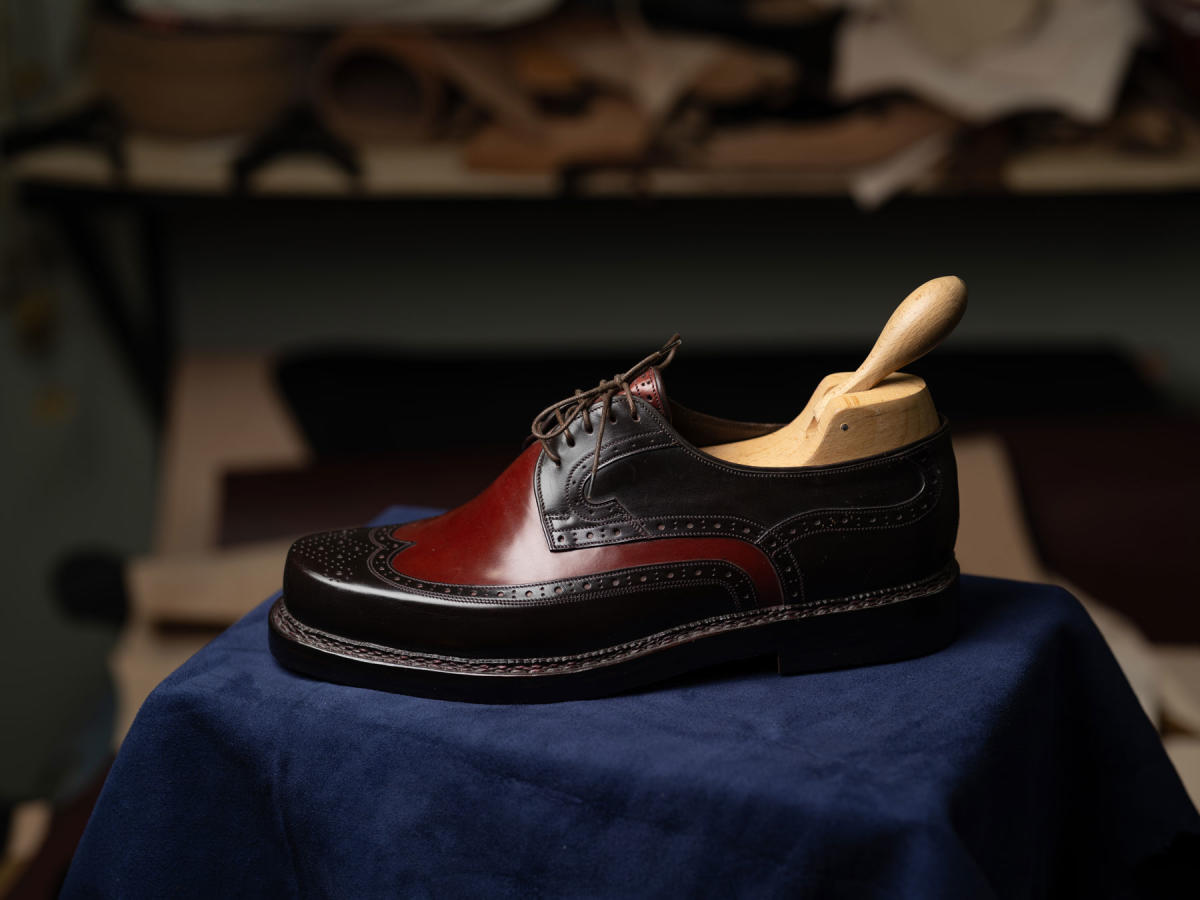
Scattered around Vasta’s shop are tools, books, sketches and piles of leather, some of which are sourced from a Pennsylvania tannery that’s been in business since 1867. His materials palette include alligator, crocodile, ostrich and calf leather. The rich scent of leather permeates the air.
“Shoe- and boot-making is art you can wear. Boot-making allows me to channel people’s desire to express themselves,” he says. “My work is about creating an object that will be treasured and remain, in time, my footprints in the sand.”
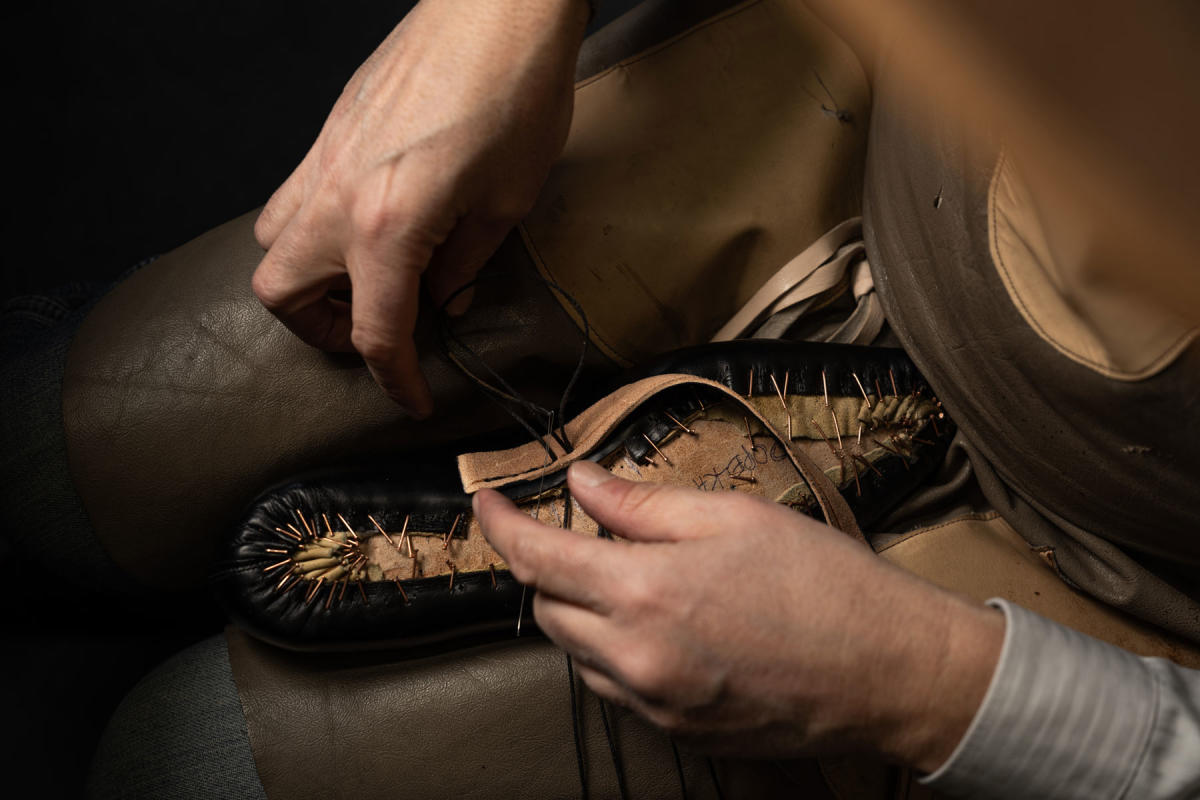
All of Vasta’s boots’ bottoms are hand-stitched, while the seams on the shafts and the decorative topstitching require industrial machine stitching. He uses an awl for hand welting, which consists of hand-stitching the boot upper, welt and insole together. He finishes the soles with lemonwood pegs for durability.
Vasta also crafts handbags, belts and, of course, dress shoes. He sees customers by appointment only. But don’t call him a cobbler. A cobbler repairs shoes. Sam Vasta is an artist—an Italian artisan from a family of makers and tailors. He is a master shoemaker.
A Shoemaker’s Secrets for Leather That Lasts
Sam Vasta was recently wearing a pair of his handcrafted Italian box calf shoes in his workshop. “The box calf is the same calf they use for filet mignon,” he explains. “Its leather is the lightest, most desirable and durable leather. You pay more for box calf shoes, but they will last a lifetime.”
Though the shoes were 25 years old, they looked brand new. A potential customer couldn’t help but ask, “What’s the secret of making your fine leather goods last a lifetime?”
“If you do your part to care for your shoes, you can hand them down through the generations, still in beautiful condition,” he replied.
To keep leather looking like new, Vasta offers the following guidelines. How often you care for your boots or shoes depends on how frequently you wear them.
- Don’t wear the same leather shoes daily. Give them time to dry inside and out.
- Use a leather conditioner to replenish the leather’s moisture.
- Use a polish cream to deepen the dye, nourish the leather and cover any scuffs.
- Use a leather wax to protect the leather’s surface and repel moisture.


